

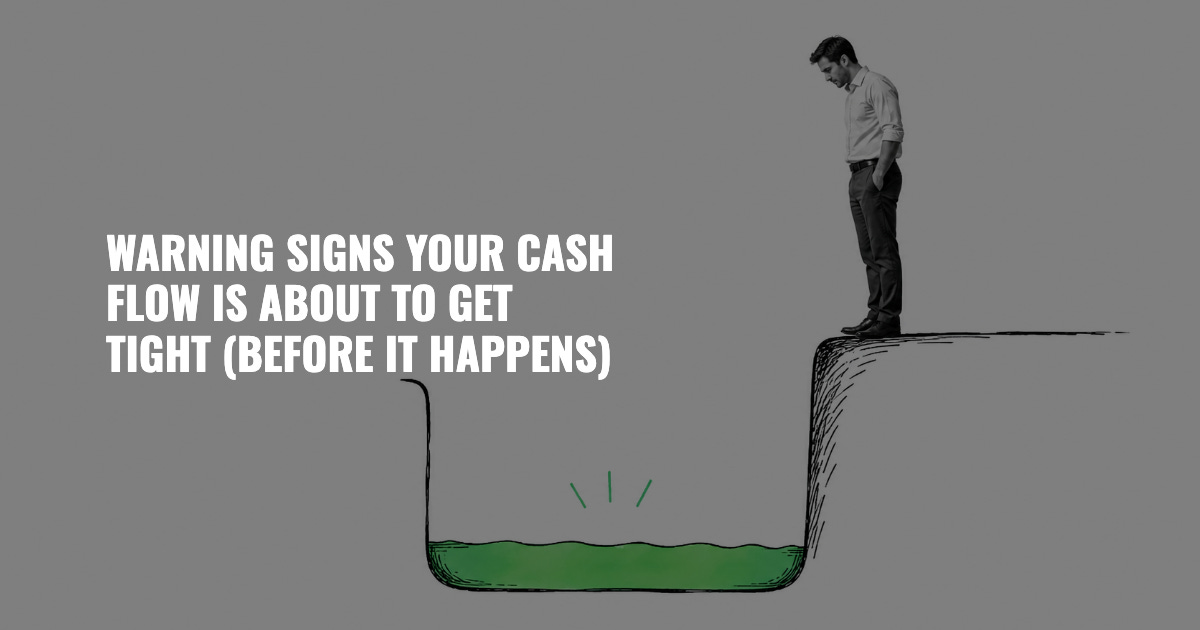
Cash flow problems rarely arrive without warning. The signs are almost always there: in your invoices, your expense patterns, your client pipeline, your balance sheet. Most business owners just don’t know what to look for.
This post changes that.
Here are four early warning signals that your cash flow is about to tighten, and what to do about each one before the squeeze arrives.
Warning Sign #1: Your Accounts Receivable Is Growing Faster Than Your Revenue
If the total amount of unpaid invoices in your accounts receivable is increasing month over month, that’s a red flag — even if your revenue looks healthy.
Growing A/R means money is being earned but not collected. Your P&L shows the income. Your bank account doesn’t have it yet. And the longer invoices sit unpaid, the lower the probability they get paid at all.
What to watch: Pull your accounts receivable aging report monthly. If you have invoices in the 60-day or 90-day column, or if the total A/R balance is climbing, your collections process needs attention now, not when cash gets tight.
What to do: Implement a consistent follow-up schedule for overdue invoices. Send a reminder at 7 days past due, a firm follow-up at 30 days, and a formal notice at 60 days. For new clients, consider requiring a deposit up front or splitting payment to reduce exposure.
Warning Sign #2: Your Client Pipeline Is Thinner Than It Was 60 Days Ago
Cash flow problems that show up in June were often planted in April. That’s because of the lag between when new business is won and when it translates into revenue and then into cash.
If your pipeline (the prospects and proposals currently in progress) has thinned out in the last 60 days, your future cash flow is already at risk, even if today’s bank balance looks fine.
What to watch: Track the total estimated value of your active pipeline each month alongside your actual revenue. A shrinking pipeline is a leading indicator of slowing revenue two to three months out.
What to do: Treat business development as a non-negotiable line item in your schedule, not something you get to when client work slows down. The goal is to always have more in the pipeline than you need, so that closing rates and timing variations don’t create cash gaps.
Warning Sign #3: You’re Using Credit to Cover Operating Expenses
Using a credit card or line of credit to cover predictable, recurring expenses (payroll, software, contractor payments) is one of the most serious early warning signs of a cash flow problem.
Occasional use of credit for strategic purchases or to bridge a timing gap is normal. Routine use of credit to fund operations means your cash inflows are not keeping pace with your obligations. The debt accumulates, interest compounds, and the gap widens.
What to watch: Review your credit card statements and line of credit balances monthly. If the balance is growing, especially if it’s growing on recurring operational charges, that pattern needs to be addressed before it becomes structural.
What to do: Build a 13-week cash flow forecast (check out this blog post) to identify exactly where the timing gaps are occurring. Then address the root cause: whether that’s slow collections, underpricing, over-spending, or a revenue shortfall.
Warning Sign #4: Your Fixed Expenses Have Grown But Your Revenue Hasn’t Kept Up
Every time you add a recurring expense, i.e., a new hire, a software tool, or an upgraded office space, your break-even point goes up. That’s fine as long as revenue grows alongside it. When it doesn’t, the margin between what you earn and what you owe shrinks quietly until it disappears.
This pattern is especially common after periods of growth. Business picks up, confidence is high, commitments are made. Then revenue plateaus or dips, but the expenses don’t.
What to watch: Calculate your monthly fixed expenses and compare them to your average monthly revenue over the past three months. The gap between those two numbers is your operating cushion. If it’s narrowing, pay attention.
What to do: Audit your fixed expenses quarterly. Identify any commitments made during a high-revenue period that are no longer justified at your current revenue level. This isn’t about cutting growth investments. It’s about making sure every fixed commitment is still earning its place.
The Common Thread
All four of these warning signs share one characteristic: they’re visible before the cash crisis arrives, if you know where to look. That’s the point of monitoring your finances consistently; not to confirm that everything is fine, but to catch the signals early enough to respond rather than react.
The business owners who navigate cash flow challenges most effectively aren’t the ones who never face them. They’re the ones who see them coming.
Want a second set of eyes on your cash flow signals? KG Virtual CFO works with coaches and consultants to identify and address financial risks before they become problems. Book a discovery call.
Cheers,
Katishia